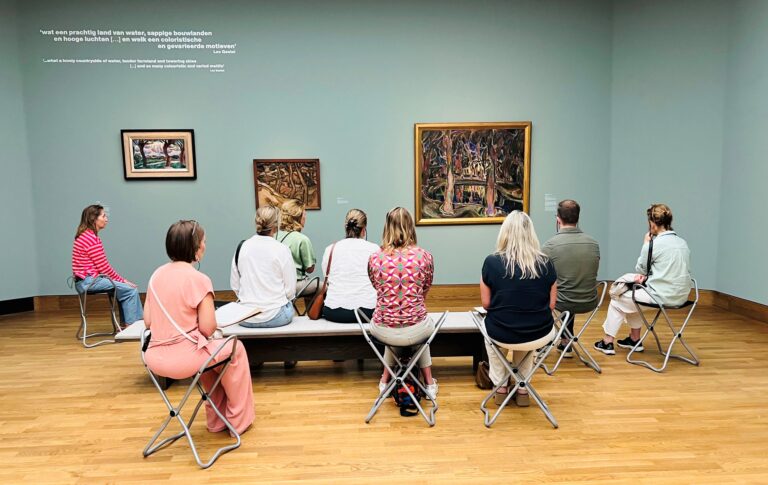






In the pilot programme GeneesKunst, Museum of the Mind, Jolien Posthumus (Mindfulness in Museums) and Barbara Doeleman (BFC Compassionate Care & Mindful Medicine) collaborated on a programme designed for people who care for others on a daily basis: doctors and healthcare professionals. Doctors and nurses from Spaarne Gasthuis participated in this museum experience, where art, mindfulness, and reflection were brought together.
The programme GeneesKunst demonstrates how museums can contribute to:
• medical education
• reflective professional practice
• the mental wellbeing of healthcare professionals
• empathetic and holistic perspectives on patients.
During the programme, participants were invited to look slowly and attentively at artworks. This way of looking made visible how quickly we tend to interpret and judge what we see.
Through this programme, we aim to support doctors’ resilience in relation to stress, while strengthening skills such as creative thinking, problem-solving, and the ability to be present with open awareness.
Looking at art also helps participants reflect differently on their own professional practice. Just as an artwork consists of different materials, techniques, and contexts that together form a whole, the same applies to the people doctors encounter.
The patient, the environment, the context, and the interaction together shape the whole picture.
When doctors work for long periods under high pressure, their sense of compassion can diminish. Mindfulness can help reconnect with this quality. When doctors lose their compassion, they may also lose the sense of meaning and joy in their work — even though compassion is often what originally drew them to the profession.
Art can play an important role in this process. Museum experiences stimulate curiosity, reflection, and empathy — qualities that are also essential in medical practice.
According to participants, the most important lesson of the programme was: to suspend judgement and remain curious.
Marie-José van Schie, coordinator for physicians in specialist training at Spaarne Gasthuis:
“My experience is that the longer you look, the more you see. You also realise how quickly you judge and place someone in a box. As a doctor, you often form an opinion about a situation very quickly. This session made me aware of that — and I saw the same awareness arise among other participants.”
Linda Witte, educational coordinator of the Master’s phase of Medicine at Spaarne Gasthuis:
“As a doctor you are trained in your first clinical impression. During GeneesKunst we learn to pause and take the time to look carefully. By looking more holistically, you become a better doctor. At the same time, the programme also creates space to support doctors’ own mental wellbeing.”
Whether you are a museum professional, healthcare professional, researcher, or educator — this project shows how art, mindfulness, and healthcare practice can strengthen one another.